
Can missing teeth be replaced?
Yes, missing teeth can be replaced, including when every tooth in one or both jaws is missing. The practical choices are conventional full dentures, implant-retained overdentures, a fixed full-arch bridge such as All-on-4 and, less commonly, multiple individual implants.
The appropriate option depends on the condition of the mouth, available jawbone, general health, budget, whether removable teeth are acceptable and willingness to complete treatment in stages. The aim is not simply to fill every tooth position. It is to choose a design that can be cleaned, maintained and supported safely.
What happens before replacement treatment starts?
Treatment normally begins with a consultation, clinical examination and imaging. The clinician uses those findings to assess the gums, bone, bite and remaining teeth, then develops a written treatment plan. An overview of how dental implants integrate with the jawbone can help you follow the terms used in that plan. Active dental disease is usually managed first, and teeth that cannot be retained may need extraction before or during later stages. The sequence is individual, so ask which findings could change the proposed design, timing or cost.
Options for replacing missing teeth
The four main options are conventional full dentures that rest on the gums, removable overdentures retained by implants, a fixed All-on-4 style bridge supported by implants and multiple individual implant restorations. Dentures involve no implant surgery, overdentures add implant retention while remaining removable, a full-arch bridge stays fixed in the mouth, and individual implants use more separately planned implant restorations.
No row is automatically better than another. Compare the likely experience of wearing and cleaning each option with its surgery, repair needs and total planned scope.
How do full dentures and implant-retained overdentures differ?
A conventional full denture rests directly on the gums and is removed for cleaning. An implant-retained overdenture connects to implants for added retention but is also removable. Its clips or other attachment parts may need maintenance or replacement as they wear.
Are individual implants practical when every tooth is missing?
Replacing every missing tooth one-for-one is not usually necessary for a full arch. A plan involving multiple individual implants may cost more and require greater surgical and restorative complexity than a shared full-arch design. Its practicality can only be judged after individual assessment.
Best way to replace missing teeth
There is no single best way to replace missing teeth for everyone. Dentures generally suit buyers prioritising lower upfront cost and less surgery, an overdenture may suit someone wanting more retention with removability, and a fixed bridge may suit an appropriate candidate who prioritises a fixed result.
The decision should account for bone volume, gum condition, treatment time and expectations about comfort and function. Hand dexterity also matters because an overdenture must be removed and cleaned, while a fixed bridge requires access and technique to clean underneath it. Every option needs continuing care, so consider whether its home cleaning and professional maintenance demands are realistic.
Who may need extra assessment before implant treatment?
People with significant bone loss, a smoking history, diabetes, relevant medicines or other health conditions may need further assessment before an implant plan is confirmed. These factors do not by themselves prove that treatment is suitable or unsuitable. A clinician should review medical and dental history, discuss risk and alternatives, and decide whether more information or preparatory care is needed.
All on 4 dental implants for missing teeth
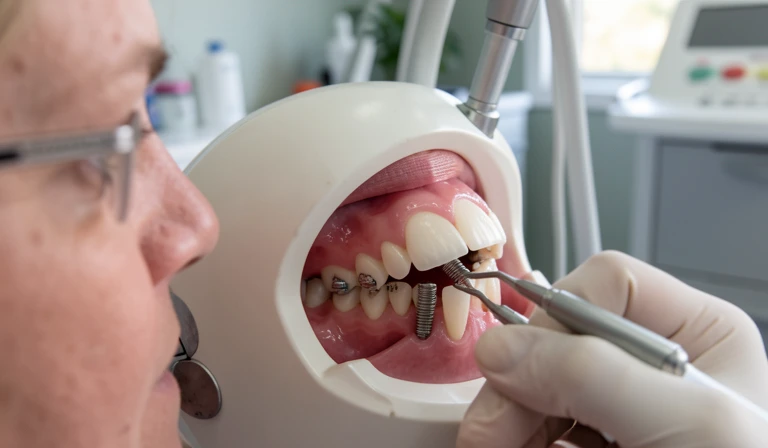
All-on-4 is a fixed full-arch bridge supported by a planned set of implants. It can be an option for some people who are missing all teeth, but suitability depends on individual clinical assessment.
Unlike an overdenture, the bridge is not removed by the patient for routine cleaning. Cleaning still needs access beneath the bridge and around its supports, with techniques and tools demonstrated by the treating team. Temporary teeth may be provided when clinically appropriate, but they are not the final prosthesis and immediate placement cannot be promised for every case. The bridge or its teeth may later need adjustment or repair, and long-term clinical and hygiene reviews remain part of care.
How is full-arch implant treatment staged?
- Assessment and planning: The clinician examines the mouth, reviews health information and uses suitable imaging to plan the case.
- Preparation: Any required extractions or grafting are planned, with their effect on timing explained.
- Implant placement: Implants are surgically positioned according to the agreed full-arch design.
- Temporary prosthesis: Temporary teeth may be fitted when the clinical conditions allow.
- Healing and final prosthesis: After the required healing and checks, the final bridge is made and fitted.
- Maintenance: Home hygiene, review visits and professional care continue after fitting.
The exact order and time between stages vary. Ask what happens if grafting, healing or implant stability changes the original schedule.
How much does a full mouth of dental implants cost?
In Australia, an All-on-4 fixed bridge is commonly quoted at roughly $15,000 to $30,000+ AUD per arch, so a full-mouth quote depends first on whether one or both arches are being treated. A single implant with crown, which is not a full-arch solution, may range from roughly $3,000 to $6,500 AUD.
Do not calculate a two-arch package from a per-arch guide and assume that it is a clinic quote. The total can change with extractions, grafting, temporary teeth, final bridge material, anaesthesia or sedation, imaging, laboratory work and the expected maintenance. Bone grafting or a sinus lift may add roughly $500 to $3,000 AUD when required, but all figures are broad market context rather than a price from a named provider.
What should a full-mouth quote include?
Obtain a written, itemised quote and check it covers:
- consultation, imaging and treatment planning;
- surgery and each implant or prosthetic component;
- temporary and final prostheses, including stated materials;
- anaesthesia or sedation;
- extractions and grafting if required;
- review visits and expected maintenance; and
- repair arrangements, warranty terms and exclusions.
Ask which items are estimates and which events could trigger an additional charge.
Full mouth dental implants cost Australia
Australian full-mouth costs vary mainly with the chosen treatment rather than one universal package price. Conventional full dentures are often roughly $1,500 to $4,000 AUD, while an All-on-4 fixed bridge is commonly quoted at roughly $15,000 to $30,000+ AUD per arch.
The lower upfront cost of dentures comes with removability and the possibility of relines, repairs or replacement as the mouth changes. A fixed bridge adds surgery and a substantially higher initial cost, but it also brings cleaning beneath the bridge, professional maintenance and possible future repair costs. Implant-retained overdentures sit between these designs in practical terms, but no numeric range should be assumed without an individual plan.
Private health fund benefits may be limited by the policy, waiting periods and annual limits, and cover is not guaranteed. Some clinics may offer payment plans, but approval, fees, interest and repayment terms vary. Compare total repayable cost rather than treating finance as a discount.
How can buyers compare quotes fairly?
Compare like with like: the number of arches, implant and prosthetic components, temporary teeth, final materials, grafting, anaesthesia or sedation, follow-up and every exclusion. Ask whether the final prosthesis, scheduled reviews and likely maintenance are included. The lowest figure is not automatically the best value if it leaves out necessary stages or provides a materially different design.
Full mouth dental implants Perth
Perth buyers should shortlist several clinics that provide the relevant full-arch option, then attend consultations before choosing. Compare the treating clinician, written treatment plan, inclusions, exclusions and aftercare at every provider.
A neutral starting list includes Perth Dental Implant Centre, Aria Dental, Next Smile Australia Perth and Radiant Smiles Dental Care. This is not a ranking or a claim that each clinic offers the same design.
- Perth Dental Implant Centre: Its name makes it an implant-focused clinic to investigate, but does not establish specialist registration, qualifications, technique or fees. Verify the proposed practitioner’s AHPRA registration and relevant experience.
- Aria Dental: This Perth private clinic is another provider to compare. Ask which full-arch options are available for the individual case and apply the same checks to its plan and clinician.
- Next Smile Australia Perth: Consider it as a branded full-arch option, while assessing the local treating clinician, exact inclusions and continuing care arrangements rather than relying on the network name.
- Radiant Smiles Dental Care: The company states that its Yokine practice offers All-on-4, implant-retained dentures and other implant services. The practice advertises a complimentary implant consultation including CBCT, but offers and suitability should be confirmed directly. Review Radiant Smiles’ published guide to full-mouth treatment options and quote inclusions before requesting a written plan.
Individual dentist names and AHPRA registration details were not found on the Radiant Smiles site, so ask who will provide treatment and independently check that practitioner on the public register. Apply that registration check to every shortlisted provider. For independent background before consenting, the Australian Dental Association consumer information site explains dental treatments and oral health topics.
What should you ask at a full-mouth implant consultation?
- Who plans and performs the surgical, temporary and final restorative stages?
- What is each practitioner’s AHPRA registration, relevant implant training and experience with comparable full-arch cases?
- Which removable and fixed alternatives were considered, and why does the proposed design suit this case?
- What is included and excluded, including temporary teeth, final materials, imaging, grafting, anaesthesia or sedation and reviews?
- How will cleaning access be provided and demonstrated?
- Who supplies aftercare, manages complications and handles repairs?
- What are the written costs if treatment or timing needs to change?